
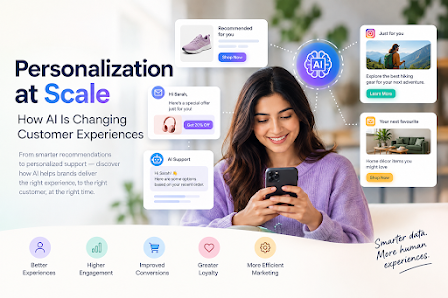
Customers today expect more than simply good products and services. They want brands to understand their needs, preferences, and interests—and they expect relevant experiences across every interaction. Whether it is a personalized product recommendation, a targeted email, or a chatbot that understands a customer’s question, personalization has become an important part of the modern customer journey.
However, delivering personalized experiences to thousands or millions of customers manually is almost impossible. This is where Artificial Intelligence (AI) is changing the way businesses approach personalization.
AI allows businesses to analyze large amounts of customer data, identify patterns, predict behavior, and deliver relevant experiences at scale. Instead of creating one marketing message for everyone, businesses can now create experiences that feel tailored to individual customers.
What Is Personalization at Scale?
Personalization at scale means using technology, automation, and customer data to provide individualized experiences to a large number of customers.
Traditional personalization might involve adding a customer’s first name to an email. Modern AI-powered personalization goes much further.
For example, an online retailer can analyze a customer’s previous purchases, browsing behavior, product searches, location, and interests. AI can then use this information to recommend products that are more likely to be relevant to that particular customer.
The goal is simple: deliver the right message, to the right customer, at the right time.
How AI Is Transforming Customer Personalization
1. AI Understands Customer Behavior
One of the biggest advantages of AI is its ability to process huge amounts of customer data quickly.
AI systems can analyze information such as:
- Website browsing behavior
- Purchase history
- Search activity
- Email interactions
- Social media engagement
- Product preferences
- Customer service conversations
By identifying patterns in this information, AI can help businesses understand what customers are interested in and what they may need next.
For example, if a customer frequently views running shoes but has not made a purchase, an AI-powered system could identify their interest and deliver relevant content, offers, or product recommendations.
2. Personalized Product Recommendations
Product recommendations are one of the most visible applications of AI personalization.
Instead of showing the same products to every visitor, AI can recommend products based on individual behavior and preferences.
For example, an e-commerce website might show one customer sportswear while showing another customer home décor products. The recommendations can change dynamically based on what each person views, clicks, and purchases.
This creates a more relevant shopping experience and can also help businesses increase engagement and conversions.
3. Smarter Email Marketing
Email marketing has traditionally relied on audience segments such as age, location, or general interests. AI allows marketers to make these campaigns much more sophisticated.
AI can help determine:
- Which products a customer may be interested in
- What type of content they are likely to engage with
- The best time to send an email
- Which customers are likely to make a purchase
- Which customers may stop engaging with the brand
Instead of sending one campaign to an entire mailing list, businesses can deliver different content to different customers automatically.
This makes email marketing more relevant while reducing the risk of customers receiving messages they do not care about.
4. AI-Powered Chatbots and Customer Support
Customer service is another area being transformed by AI.
AI-powered chatbots can provide personalized responses based on customer questions, previous interactions, and available account information. Instead of giving every customer the same generic response, AI can help businesses provide more context-aware assistance.
For example, an online travel company could use AI to recommend destinations based on a customer’s previous searches and preferences. A retailer could help a customer track an order or find products based on their previous purchases.
AI can also provide 24/7 support, helping customers receive immediate assistance even outside normal business hours.
5. Predictive Personalization
One of the most powerful applications of AI is predicting what customers might do next.
AI can analyze historical behavior to identify potential future actions. For example, it may predict that a customer is likely to purchase a particular product, upgrade a subscription, or stop using a service.
Businesses can then use these insights to take proactive action.
For example, a subscription company might identify customers who are showing signs of becoming inactive and send them personalized content or an offer designed to encourage continued engagement.
This changes personalization from simply responding to customers to anticipating their needs.
6. Personalized Content Creation
Generative AI is also changing content personalization.
Businesses can use AI to create variations of advertisements, emails, product descriptions, social media posts, and other marketing content for different audiences.
For example, the same product could be promoted using different messages depending on the customer’s interests.
A fitness-focused customer might see content emphasizing performance, while another customer might see content emphasizing comfort and convenience.
This allows marketers to experiment with different messages without manually creating every variation.
The Benefits of AI-Powered Personalization
When implemented correctly, personalization at scale can provide significant benefits.
Better Customer Experiences
Customers are more likely to engage with content that is relevant to their needs and interests.
Higher Engagement
Personalized recommendations, emails, and advertisements can encourage customers to interact more frequently with a brand.
Improved Conversion Rates
When customers see products and offers that match their interests, they may be more likely to make a purchase.
Greater Customer Loyalty
Customers who consistently receive useful and relevant experiences may develop stronger relationships with a brand.
Improved Marketing Efficiency
AI can automate many personalization tasks, allowing marketing teams to focus more on strategy and creativity.
The Challenges of Personalization at Scale
Despite its benefits, AI personalization also comes with challenges.
The first is data privacy. Businesses need to collect and use customer information responsibly. Customers should understand how their data is being used, and businesses must follow applicable privacy regulations.
The second challenge is over-personalization. Just because a business can use customer data does not mean it should use every available piece of information. Personalization should feel helpful rather than intrusive.
Another challenge is maintaining the human element. AI can analyze data and automate communication, but customers still value empathy, creativity, and genuine human interaction.
The best approach is not AI versus humans. It is AI + humans.
How Businesses Can Start With AI Personalization
Businesses do not need to transform their entire marketing strategy overnight. A practical approach is to start with one customer experience.
For example:
- Identify an important customer journey.
- Collect relevant first-party customer data.
- Use AI to identify patterns and preferences.
- Create personalized content or recommendations.
- Test the results.
- Improve the strategy based on customer feedback and performance.
Starting small allows businesses to understand what works before expanding personalization across multiple channels.
The Future of Customer Experience Is Personalized
AI is changing personalization from a limited marketing tactic into a broader customer experience strategy.
In the future, customers will increasingly expect brands to understand their preferences and provide relevant experiences across websites, apps, email, social media, advertising, and customer support.
However, successful personalization will not simply be about using more data or more advanced AI. It will be about using technology responsibly to make customer interactions genuinely more useful.
The brands that succeed will be those that combine AI-driven insights with human creativity, transparency, and empathy.
Personalization at scale is no longer just a competitive advantage. It is becoming an essential part of delivering the kind of customer experience people expect from modern brands.